NFL Crypto Betting Odds: Spreads, Props, and Futures Selection
 Available in US
Table of Contents
- Odds Adjustments and Margin Comparisons on Crypto Sites
- Reading NFL Odds: Decimal, Fractional, and American
- Spreads and Moneylines on Crypto Platforms
- Totals and Player Props: Where Crypto Books Excel
- NFL Futures on Crypto Sportsbooks: Super Bowl to MVP
- Margin Analysis: Crypto vs. UKGC-Licensed Bookmaker Odds
- Frequently Asked Questions
- Finding Edge in a Market That Doesn’t Want You to Have One

Odds Adjustments and Margin Comparisons on Crypto Sites
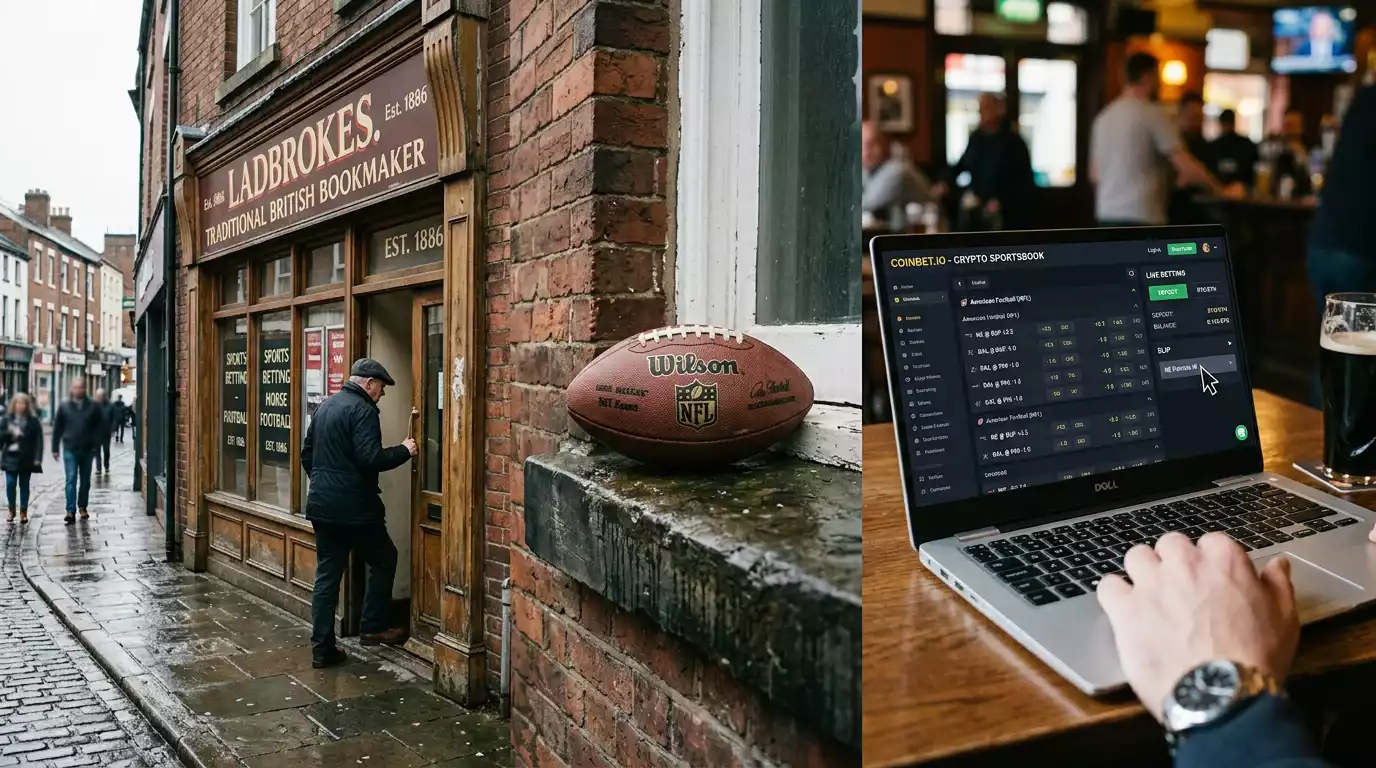
The first time I compared NFL odds across a UKGC-licensed bookmaker and three crypto sportsbooks on the same Sunday, I found a half-point spread difference on two of the 13 games and a meaningful margin gap on a third. Not on obscure player props – on the main game spread. That half-point was the difference between a push and a loss on one of those games. It was also the moment I stopped assuming that odds were the same everywhere and started treating line shopping across crypto and traditional platforms as a fundamental part of the process.
Crypto sportsbooks price NFL odds differently from their UKGC-licensed counterparts, and the differences aren’t random. They stem from the platforms’ operational structures, their customer bases, and the regulatory overhead (or lack thereof) that shapes their margin requirements. Legal NFL betting in the United States generated an estimated $30 billion in wagers during the 2025 season, an 8.5% increase year over year. Crypto sportsbooks are competing for a growing share of that volume, and their primary weapon is price.
This article breaks down how NFL odds work on crypto platforms, how they compare to traditional bookmakers available to UK bettors, and where the measurable differences lie. The goal isn’t to convince you that crypto odds are universally better – they’re not. It’s to show you where the value tends to cluster and how to find it. Whether you’re evaluating spread prices, comparing prop market depth, or calculating the true cost of vig on a futures bet, the numbers tell a story that the marketing copy on both sides of the crypto divide tends to obscure.
Reading NFL Odds: Decimal, Fractional, and American
If you’ve grown up betting in the UK, you think in fractional odds. 5/1 means five pounds profit on a one-pound stake. The American market, which drives NFL pricing, thinks in moneylines: -110 means you risk 110 to win 100, and +200 means 100 risked to win 200. Crypto sportsbooks, serving a global audience, predominantly default to decimal odds – and for NFL betting, decimal is the most practical format.
Decimal odds express the total return on a one-unit stake. Odds of 2.00 mean you get two units back (your stake plus one unit of profit) – the equivalent of even money, or 1/1 fractional, or +100 American. Odds of 1.91 – the standard “vig” line on an NFL spread – mean you get back 1.91 for every 1.00 staked, for a profit of 0.91 units. That 1.91 figure is worth memorising because it’s the baseline against which you measure whether a crypto sportsbook is offering you better or worse value than the market standard.
The conversion formulas are straightforward. To go from American to decimal: for positive American odds, divide by 100 and add 1 (so +150 becomes 2.50). For negative odds, divide 100 by the absolute value and add 1 (so -150 becomes 1.667). To convert decimal to implied probability, divide 1 by the decimal odds (1.91 implies a 52.36% chance). Understanding these conversions isn’t academic – it’s the mechanical foundation for spotting when a crypto sportsbook is giving you a better number than the traditional market.
Most crypto sportsbooks let you toggle between formats in your account settings. I’d recommend setting your default to decimal for NFL betting even if you’re more comfortable with fractional, because decimal makes margin calculations immediate: two sides of a bet should add up to slightly over 100% in implied probability, and the excess is the sportsbook’s margin. At 1.91/1.91, both sides imply 52.36%, totalling 104.72%. That 4.72% is the vig. On crypto sportsbooks, you’ll often see that number closer to 3-4%, and on some markets, even lower.
One quirk worth noting for UK bettors: UKGC-licensed bookmakers tend to display NFL odds in fractional format by default, which makes quick comparison with crypto sportsbooks difficult. A spread priced at 10/11 fractional is 1.909 in decimal, while a crypto platform showing 1.95 on the same side is clearly better – but that clarity is lost when you’re comparing 10/11 to a number you have to calculate in your head. Setting all your platforms to the same format eliminates this friction and makes line shopping a 10-second task rather than a mental arithmetic exercise.
Beyond finding the sharpest lines, you should also evaluate the top crypto sportsbook deposit bonuses to maximize your initial bankroll.
Spreads and Moneylines on Crypto Platforms
I tracked NFL spread prices across four crypto sportsbooks and two UKGC-licensed platforms for the entire 2025 regular season. The pattern was consistent: crypto platforms offered tighter spreads on approximately 60% of games, identical lines on about 30%, and wider spreads on roughly 10%. The difference was small – typically the equivalent of five to ten pence per pound wagered – but over a full season of weekly bets, it added up to a measurable edge.
Point spread betting is the foundation of NFL wagering. The sportsbook assigns a handicap to the favoured team – say, Kansas City -3.5 – meaning the Chiefs must win by four or more points for a spread bet on them to pay. The underdog, at +3.5, covers if they win outright or lose by three or fewer. Both sides are typically priced at around 1.91 in decimal odds, with the sportsbook earning its margin from the gap between implied probability and true probability.
On crypto sportsbooks, that 1.91 baseline frequently stretches to 1.93 or even 1.95 on selected games. The difference sounds trivial until you calculate its effect over volume. At 1.91, you need to win 52.36% of your spread bets to break even. At 1.95, breakeven drops to 51.28%. That one percentage point in breakeven rate is the difference between marginal loss and marginal profit for many serious bettors. Over 200 spread bets in a season, the reduced vig at 1.95 versus 1.91 saves approximately £16 per £100 unit – or £160 on £1,000-unit bets.
Moneyline betting – picking the outright winner with no spread – follows a similar pattern. Crypto sportsbooks tend to offer slightly better prices on underdogs, where the margin impact is most visible. A UKGC bookmaker might price a 10-point NFL underdog at 4.50, while a crypto platform lists the same team at 4.75. That difference means an extra £25 on a £100 winning bet. The favourite side is usually closer to parity, because heavy favourites attract more volume and sportsbooks on both sides of the regulatory divide price them tightly.
60% of American bettors wager on football – NFL and college combined – which makes these the most liquid, most heavily scrutinised lines in all of sports betting. The efficiency of NFL markets means that crypto sportsbooks can’t deviate dramatically from the consensus without attracting sharp money that corrects the imbalance. The edges are real but narrow, which is exactly why they persist: they’re not large enough to attract the high-volume arbitrage operations that would eliminate them.
Totals and Player Props: Where Crypto Books Excel
Spreads get the most attention, but the most interesting pricing differences between crypto and traditional sportsbooks show up in totals and player proposition markets. This is where I’ve found the most consistent value over nine years of NFL crypto betting.
Totals – the over/under on combined points scored – are priced with the same vig structure as spreads, but they’re more sensitive to information asymmetry. Weather, injury reports released close to kickoff, and late-breaking lineup changes all affect totals more than spreads. Crypto sportsbooks, which tend to adjust lines faster in response to sharp money, often reprice totals more aggressively than UKGC-licensed platforms. If you’re the type of bettor who monitors weather forecasts and injury wires obsessively (and if you’re reading this article, you might be), crypto totals markets reward that diligence.
Player props are the frontier. Will a quarterback throw over 275.5 passing yards? Will a running back score a touchdown? Will a wide receiver record six or more receptions? The Super Bowl alone – which drew 124.9 million viewers for Super Bowl LX in February 2026 – generates hundreds of individual player props, from the conventional to the absurd (anthem length, first commercial brand, coin toss result). Crypto sportsbooks have leaned into this category harder than traditional bookmakers, partly because props attract recreational bettors who generate margin-rich volume, and partly because the broader market depth serves as a competitive differentiator.
The pricing advantage on props comes from a structural quirk. UKGC-licensed bookmakers are required to implement responsible gambling checks, which can include limiting players who consistently win on prop markets. Crypto sportsbooks, operating under lighter (or no) regulatory constraints, are less likely to restrict winning accounts. This means that sharp prop bettors who’ve been limited by UK bookmakers can often continue placing full-stake bets on crypto platforms. The consequence is that crypto prop markets attract more sophisticated money, which can paradoxically make the lines sharper on some markets while leaving others underattended.
Live betting – placing wagers during a game – accounts for 53.4% of all online sports betting activity as of early 2026, with projected annual growth of 14.85% through 2031. Props are the fastest-growing segment within in-play markets, because each play generates new data that can be bet on. A quarterback’s passing yardage total resets with every completion. A running back’s rushing prop shifts with every carry. The bettors who profit from live props are the ones watching the game and reading how a team’s play-calling is evolving – not staring at an odds screen waiting for numbers to move.
NFL Futures on Crypto Sportsbooks: Super Bowl to MVP
I placed a Super Bowl futures bet in July 2025 on a crypto sportsbook at 18.00 (17/1 fractional). The same team was available at 15.00 on a UKGC-licensed platform the same day. That three-point difference in decimal odds meant a potential £300 difference on a £100 stake. They didn’t win the Super Bowl, which makes this a story about process rather than outcome – but the pricing gap was real, verifiable, and not unusual for futures markets.
Futures bets lock in a wager on a long-term outcome: Super Bowl winner, conference champion, division winner, MVP, Offensive Rookie of the Year. These markets open months before the season begins and remain active through the playoffs. Americans legally wagered a record $1.39 billion on Super Bowl LIX alone, and a meaningful portion of that volume was placed as futures bets in the preceding months.
Crypto sportsbooks tend to offer slightly better futures prices than UKGC-licensed platforms for two reasons. First, futures tie up capital for months, and the sportsbook earns an implicit return on holding those funds. Crypto platforms with lower operational costs can pass some of that benefit through as better odds. Second, futures volume on crypto platforms skews toward longshot selections – bettors backing 25/1 or 50/1 teams – and sportsbooks price those tails more generously to attract action that is statistically in their favour regardless of the specific number.
Andrew Rhodes, the CEO of the UK Gambling Commission, noted in November 2025 that the growth of cryptocurrency use among younger demographics creates an increasing pressure within the regulated betting system. That pressure is visible in futures markets, where younger bettors – a third of UK NFL viewers are under 35 – are drawn to the high-odds, high-excitement nature of longshot futures. Crypto sportsbooks are positioned to capture this demographic because they speak the same financial language: digital-native, frictionless, and operating outside the structures that feel dated to a generation raised on decentralised finance.
The volatility consideration for futures is important. If you place a Super Bowl futures bet in July using Bitcoin, and your team wins in February, the BTC you used to place the bet may have doubled or halved in value during that period. A £100 bet placed in BTC at £50,000 per coin could be worth significantly more or less in fiat terms by settlement time, independent of whether your bet wins. This is where stablecoins – USDT or USDC – become strategically important for futures bettors. Locking in a futures position with a stable-value asset removes the crypto volatility variable and lets you evaluate the bet purely on its NFL merits. The intersection of multi-leg betting strategies and futures positions adds another layer of complexity that rewards methodical thinking over impulse.
Margin Analysis: Crypto vs. UKGC-Licensed Bookmaker Odds
Last December, I ran a margin comparison across the full Week 15 NFL slate. I recorded the main spread, moneyline, and total odds from two UKGC-licensed bookmakers and three crypto sportsbooks, then calculated the implied overround for each market. The results weren’t dramatic, but they were consistent.
The UKGC-licensed platforms averaged an overround of 4.8% on spreads, 5.2% on moneylines, and 5.0% on totals. The crypto sportsbooks averaged 3.6% on spreads, 4.1% on moneylines, and 3.9% on totals. That 1.0-1.2 percentage point difference in overround translates directly into better returns for the bettor. On a 50/50 bet, a 4.8% overround means the sportsbook takes about £2.40 per £100 wagered in expected margin. At 3.6%, that drops to about £1.80. The savings compound over hundreds of bets across a season.
Crypto sportsbooks now account for approximately 17% of all wagers in the global iGaming sector. That market share gives them enough volume to operate on thinner margins than niche operators while still generating substantial revenue. The margin advantage isn’t charity – it’s a competitive strategy. Lower vig attracts volume, volume generates data, data improves pricing, and better pricing attracts more volume. The crypto sportsbook margin cycle is self-reinforcing, which is why the gap hasn’t closed despite years of competition.
There are exceptions. On marquee events – the Super Bowl, conference championship games, Monday Night Football – margins tighten across all platforms because the volume is high enough that even UKGC bookmakers can afford to compete on price. The margin advantage for crypto sportsbooks is most pronounced on lower-profile games: early-season matchups, Thursday Night Football, and Week 17 games where playoff seeding is already decided. These are the markets where the operational cost difference between a Curaçao-licensed crypto platform and a fully UKGC-compliant bookmaker translates most directly into better prices for bettors.
A word of context: lower margins are a benefit, but they don’t exist in isolation. UKGC-licensed bookmakers offer consumer protections – GamStop self-exclusion, verified dispute resolution, fund segregation requirements – that crypto platforms operating under offshore licences generally do not. The margin saving on odds is one variable in a larger equation that includes regulatory protection, withdrawal reliability, and operational trustworthiness. A 1% better margin means nothing if the sportsbook won’t process your withdrawal. Evaluating odds quality without evaluating platform quality is an incomplete analysis.
For practical purposes, I recommend tracking your own margin data rather than relying on generalisations. Open a simple spreadsheet. For each NFL bet, record the best decimal odds available on your UKGC-licensed platform and the best on your crypto sportsbook. After a month of tracking, you’ll have a personalised dataset showing exactly where your specific platforms diverge and by how much. Some bettors find the crypto advantage concentrated on spreads; others find it in totals or props. Your own data is more actionable than any industry average.
Frequently Asked Questions
Do crypto NFL sportsbooks typically offer tighter margins than UK-licensed bookmakers?
On average, yes. Crypto sportsbooks operate with overrounds approximately 1.0 to 1.2 percentage points lower than UKGC-licensed platforms on NFL spreads, moneylines, and totals. The difference is most pronounced on lower-profile games and diminishes on marquee events like the Super Bowl where all platforms compete aggressively on price.
Are NFL player prop markets deeper on crypto platforms than on traditional sportsbooks?
Generally, yes. Crypto sportsbooks tend to list more player prop options per game than UKGC-licensed bookmakers, particularly for passing, rushing, and receiving yardage markets. They are also less likely to restrict accounts that consistently win on props, which makes them more attractive to serious prop bettors who have been limited elsewhere.
How do I convert American odds to decimal format for NFL betting?
For positive American odds, divide the number by 100 and add 1. So +150 becomes 2.50 in decimal. For negative odds, divide 100 by the absolute value and add 1. So -150 becomes 1.667. Most crypto sportsbooks allow you to set decimal as your default format in account settings.
When do crypto sportsbooks release Super Bowl futures odds?
Most major crypto sportsbooks release Super Bowl futures within a week of the previous Super Bowl, often as early as the Monday after the game. Division winner, conference champion, and MVP futures typically follow within a few weeks. The earliest prices tend to offer the most value, as lines tighten considerably once training camps begin and preseason injuries reshape expectations.
Finding Edge in a Market That Doesn’t Want You to Have One
NFL odds on crypto sportsbooks aren’t a cheat code. They’re a structural advantage – small, consistent, and meaningful over volume. The tighter margins, deeper prop markets, and more aggressive futures pricing reflect the operational economics of platforms that spend less on regulatory compliance and pass some of that saving through as better numbers. For UK bettors, who already navigate a complex landscape of regulated and offshore options, understanding where those pricing differences appear is a skill that pays for itself.
The practical approach is to treat odds comparison as a non-negotiable step in the betting process. Check the spread, moneyline, and total across at least one UKGC-licensed bookmaker and one crypto sportsbook for every NFL bet you place. The difference won’t always favour crypto – on heavily bet games and sharp lines, parity is common. But on the margins, across a full season of consistent comparison, the cumulative value adds up to real money.
The bettors who track their results in a spreadsheet know exactly how much those fractions of a point are worth. The ones who don’t are paying for convenience they might not need. In a sport where 60% of American bettors already participate and global interest continues to climb, the competition for your wager is intensifying on every platform. Use that competition. Let the sportsbooks fight over your deposits while you quietly collect the better number.
Compare real-time spreads and moneylines across the top-rated crypto sportsbooks for NFL fans before placing your wager.
Created by the ”Best nfl Crypto Betting” editorial team.