NFL Crypto Betting Bankroll Management: Protecting Your Balance Against Volatility and Variance
 Available in US
Two Risks at Once: Market Variance and Asset Volatility
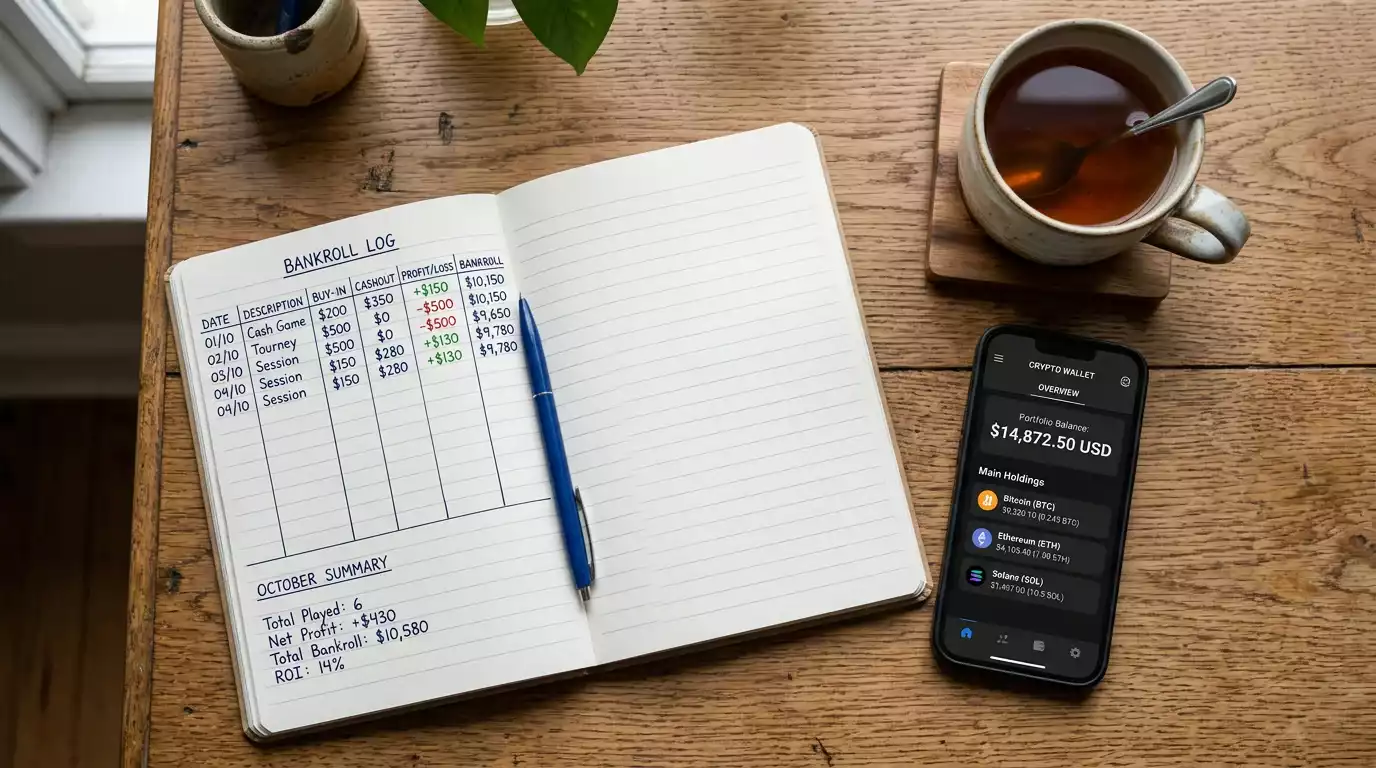
I learned about dual-risk exposure the hard way during my second NFL season betting with Bitcoin. I was running well — up 12 units on my football picks through Week 10 — but my bankroll in fiat terms was flat because BTC had dropped 20% over the same period. My NFL analysis was sharp. My bankroll management was not. The frustration of winning bets and not making money is a uniquely crypto problem, and it taught me that bankroll strategy in crypto sports betting requires a framework that traditional betting guides do not address.
In fiat betting, your bankroll faces one source of variance: the outcome of your bets. In crypto betting, it faces two: bet outcome variance and asset price volatility. Bitcoin dominates with roughly 66% of all crypto gambling volume, and BTC’s price can swing 5% to 10% in a single week. If your entire NFL bankroll is denominated in a volatile asset, you are running two independent books simultaneously — one as a football analyst and one as a crypto speculator. Managing both requires deliberate structure.
Defining a Unit When Your Currency Moves 5% a Day
Traditional bankroll management centres on the unit — a fixed percentage of your total bankroll that you risk on each bet. A common recommendation is 1% to 3% per wager. The logic is sound: fixed-percentage staking ensures that a losing streak reduces your exposure proportionally, protecting you from ruin.
The problem with applying this directly to a BTC-denominated bankroll is that your unit size changes in fiat terms even when your balance does not. If your bankroll is 0.1 BTC and your unit is 1% — 0.001 BTC — the fiat value of that unit fluctuates with the Bitcoin price. At GBP 50,000 per BTC, your unit is GBP 50. At GBP 45,000, it is GBP 45. At GBP 55,000, it is GBP 55. Over a 17-week NFL season, that range can be far wider.
My approach is to define units in fiat terms and convert to crypto at the time of each bet. I set my unit at GBP 50, and before placing a wager, I calculate how much BTC (or USDT) that represents at the current exchange rate. This means my unit size in crypto fluctuates, but my risk in real-money terms remains constant. The alternative — fixing units in BTC — means your risk in pounds is at the mercy of a market you are not actively analysing or trading.
Some bettors prefer to fix units in crypto and accept the fiat variability, treating their sportsbook balance as a separate asset class. That approach is valid if you are genuinely comfortable with the additional volatility and do not plan to convert your winnings back to GBP in the near term. But most UK bettors I know think about their bankroll in pounds, evaluate their performance in pounds, and ultimately spend their winnings in pounds. Aligning your unit definition with your reference currency keeps your risk management honest.
Using Stablecoins as a Bankroll Anchor
The simplest solution to the dual-risk problem is to remove one of the risks entirely. Stablecoins — USDT and USDC — are projected to account for more than 70% of all crypto wagers by 2026, and bankroll stability is a primary driver of that adoption.
When your sportsbook balance is held in USDT, your bankroll’s fiat value is stable regardless of what Bitcoin, Ethereum, or any other volatile asset does. Your unit size is constant. Your profit-and-loss tracking is straightforward. And your performance evaluation reflects your NFL betting skill alone, without the noise of asset price movement.
The trade-off is that you forfeit potential upside from crypto appreciation. A bettor who held their bankroll in BTC from September 2024 to February 2025 would have seen a significant fiat gain on top of any betting profits, purely from Bitcoin’s price movement. Stablecoins eliminate that upside along with the downside, and some bettors view that as an unacceptable opportunity cost.
My compromise is a split approach. I keep 70% to 80% of my NFL crypto bankroll in stablecoins — this is my working capital, the funds I actively bet with. The remaining 20% to 30% sits in BTC or ETH as a long-term position that I do not touch for betting. This structure gives me a stable base for wagering while maintaining exposure to crypto appreciation in a portion I can afford to hold through volatility. The two allocations have different purposes, different time horizons, and different rules.
When and How to Move Funds Off the Sportsbook
Your crypto sportsbook is not a bank. It is not insured, it is not regulated to the same standards as a UK financial institution, and if it experiences a security breach, an insolvency event, or a sudden closure, your balance may be unrecoverable. Keeping the minimum necessary funds on the platform is a risk management practice that too many bettors ignore until it is too late.
I operate on a simple withdrawal schedule: at the end of each NFL week, I withdraw any balance above my working capital threshold. If my working capital target is the equivalent of 50 units and my balance has grown to 65 units after a winning week, I withdraw 15 units to my personal wallet. If my balance has shrunk to 40 units after a losing week, I leave it in place and reassess my unit size.
The withdrawal trigger should reflect your betting volume and the platform’s processing speed. If you bet on three to five NFL games per week at 2 units each, a working capital buffer of 30 to 50 units covers two to three weeks of activity with room for variance. Anything above that buffer should be in your own wallet, under your own control.
Timing withdrawals can also manage tax exposure. If you are betting with BTC and your coins have appreciated since purchase, withdrawing to a personal wallet does not trigger a capital gains event — you are simply moving assets between addresses you control. The taxable disposal occurs only when you sell, exchange, or spend the crypto. Spacing out fiat conversions across tax years can help manage your annual capital gains allowance, though this is a question for your accountant rather than a general strategy guide.
Frequently Asked Questions
Should I convert my NFL crypto bankroll to USDT between game weeks?
If you are concerned about Bitcoin price volatility affecting your bankroll between game weeks, converting to USDT is a reasonable approach. The conversion itself may create a small taxable event if your BTC has appreciated, but it eliminates the risk of a mid-week price drop reducing your fiat-equivalent balance before the next slate of games.
What percentage of a crypto bankroll should a single NFL bet represent?
A single NFL bet should represent 1% to 3% of your total bankroll, the same range recommended for fiat betting. If you are betting with a volatile asset like Bitcoin, defining your unit in fiat terms and converting at the time of each bet ensures your actual risk remains consistent regardless of crypto price movement.
How does Bitcoin price volatility change my effective unit size over an NFL season?
Significantly. Over a typical 18-week NFL season, Bitcoin’s price can move 30% or more in either direction. A 1% unit that starts at GBP 50 could represent GBP 35 or GBP 65 by season’s end, purely from asset price movement. This is why many crypto NFL bettors define units in fiat and convert per bet, or use stablecoins to maintain consistent unit sizing.
Discipline Is the Edge That Compounds
Every NFL bettor talks about finding edge in the lines. Fewer talk about the edge that comes from not losing money to poor bankroll management — but over a full season, it is the larger factor. A 3% edge on your picks means nothing if a 15% BTC drawdown wipes out your gains, or if an aggressive staking plan turns a manageable losing streak into a bankroll crisis.
Define your units in the currency you think in. Use stablecoins for your working capital. Withdraw profits regularly to a wallet you control. And treat your sportsbook balance as a tool, not a savings account. The bettors who build sustainable NFL crypto strategies are not the ones with the sharpest picks — they are the ones who protect their capital well enough to keep betting through the inevitable cold stretches until the edge reasserts itself.
Published by the Best nfl Crypto Betting team.